


This section will feature information about our research users and their experiences with CropWizard. Content coming soon.
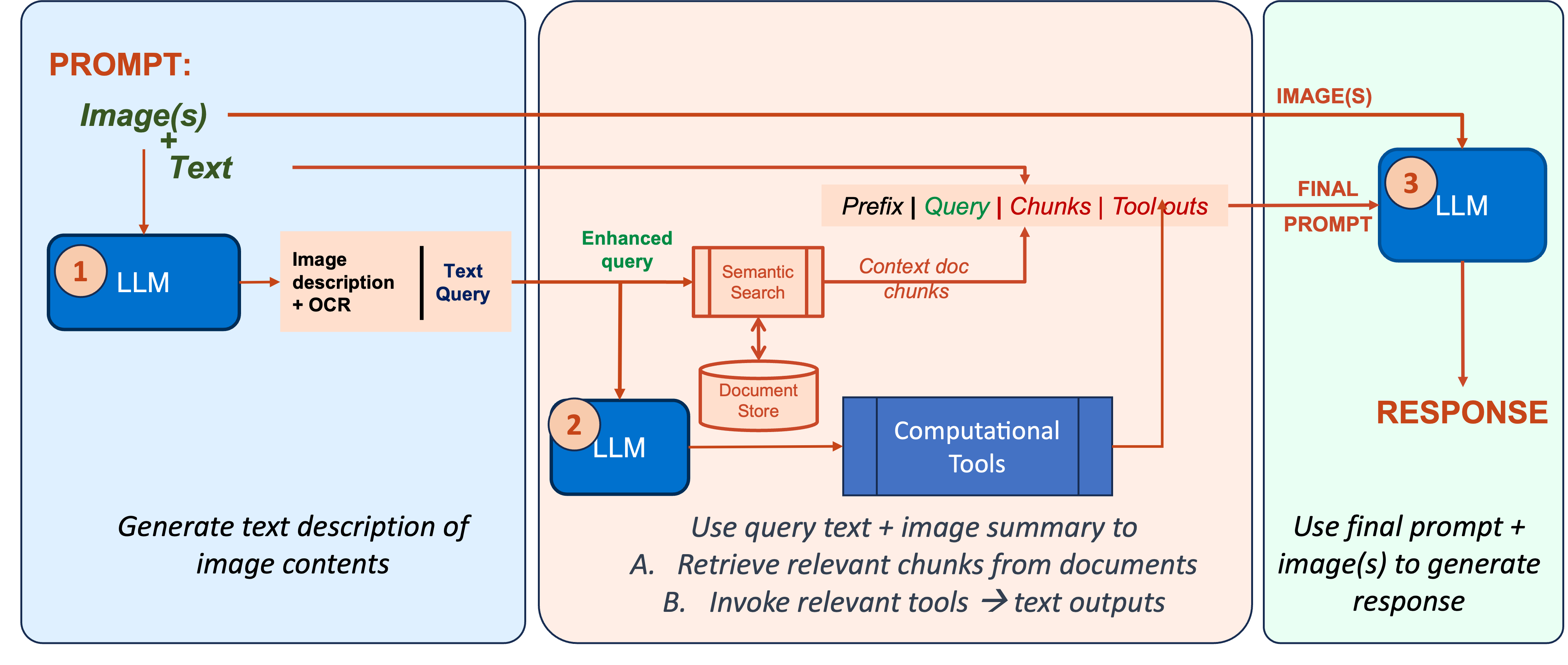
CropWizard is one of the first significant research applications built entirely on the Illinois Chat platform, a new campus-developed artificial intelligence software tool by the National Center for Supercomputing Applications (NCSA) for the University of Illinois Urbana-Champaign community. While Illinois Chat was designed to give faculty, students, and researchers a secure way to build their own customizable chatbots with local data and privacy safeguards, CropWizard takes that same technology into the field, literally. Developed through the Center for Digital Agriculture, AIFARMS National AI for Agriculture Institute, and NCSA, CropWizard serves as an interactive question-answering and decision-support service powered by generative AI designed for agricultural professionals.
CropWizard's RAG database contains over 200,000 curated agricultural documents, including Extension publications from U.S. land-grant universities, peer-reviewed research papers, and agricultural best practices guides. The database is continuously updated with new publications and is indexed for efficient retrieval of relevant information based on user queries.
CropWizard employs advanced computer vision models to analyze agricultural images uploaded by users. The system can identify plant species, detect diseases and pests, assess crop health, and recognize various agricultural conditions. Images are processed using state-of-the-art multimodal AI models that combine visual understanding with contextual agricultural knowledge to provide accurate diagnoses and recommendations.
CropWizard integrates a suite of specialized agricultural tools and agents, including crop management calculators, pest identification systems, disease diagnosis tools, nutrient requirement analyzers, and weather-based recommendation engines. These tools work together to provide comprehensive, data-driven agricultural advice tailored to specific user needs and local conditions.
This section will feature information about our research users and their experiences with CropWizard. Content coming soon.
MIRAGE-MMST is a benchmark designed to assess multimodal vision-language models on expert-level, single-turn agricultural consultations. Each instance includes a natural-language question, user-submitted images, and associated metadata (e.g., timestamp, location). Models must identify relevant agronomic entities, reason causally about observed visual symptoms, and generate explanatory or actionable management recommendations.
MIRAGE-MMMT is a multimodal decision-making task, grounded in real-world agricultural consultations. Users pose complex, often image-supported questions about plant health, pest identification, growing conditions, and other agronomic concerns. Each dialogue reflects a practical scenario in which the expert must reason over conversation history and visual context to decide: (1) whether to respond with guidance based on what is known, or (2) whether to pause and seek additional input to resolve a knowledge gap. This introduces a decision-making challenge tightly coupled with natural language generation.
AgMMU is a comprehensive agricultural multimodal understanding benchmark designed to evaluate vision-language models on various agricultural tasks. The benchmark encompasses diverse challenges including plant identification, disease detection, pest recognition, and agricultural scene understanding.
AgMMU provides a rigorous evaluation framework for assessing the capabilities of multimodal AI systems in agricultural contexts, covering a wide range of real-world scenarios and applications.
MIRAGE: A Benchmark for Multimodal Information-Seeking and Reasoning in Agricultural Expert-Guided Conversations
Vardhan Dongre, Chi Gui, Hooshang Nayyeri, Shubham Garg, Gokhan Tur, Dilek Hakkani-Tür, Vikram Adve
NeurIPS 2025 Datasets & Benchmarks Track
AgMMU: A Comprehensive Agricultural Multimodal Understanding Benchmark
Aruna Gauba, Irene Pi, Yunze Man, Ziqi Pang, Vikram S. Adve, Yu-Xiong Wang
NeurIPS 2025 Datasets & Benchmarks Track
This work is partly supported by the AIFARMS National AI Institute and Center for Digital Agriculture at the University of Illinois, with support from Amazon, IBM, and Discovery Partners Institute. This work used Delta advanced computing and data resource at University of Illinois Urbana-Champaign and its National Center for Supercomputing Applications, which is supported by U.S. National Science Foundation grants #2138259, #2138286, #2138307, #2137603, and #2138296.